Views: 53 Author: Curry Publish Time: 2024-01-16 Origin: Site
Ethernet was invented by American computer scientists Bob Metcalfe and David Boggsat Xerox PARC in the early 1970s. The work they conducted at the research center eventually evolved into the prototype of Ethernet, one of the foundations of modern computer networks.
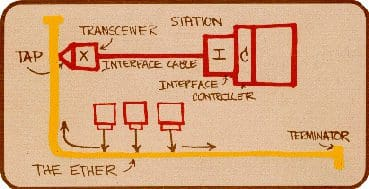
Ethernet was originally a local area network (LAN) technology designed to connect computers and share resources such as printers. Its original intention is to provide high-speed, reliable data transmission within a local area network to promote resource sharing and cooperative work.
Unlike the history of the Roman Empire, the development of Ethernet did not go through an obvious period of decline. Instead, it has become an essential part of the global computer network while constantly evolving and adapting to new technologies. The invention of Ethernet marked the beginning of a new era of computer networks and laid the foundation for the subsequent rise of the Internet.
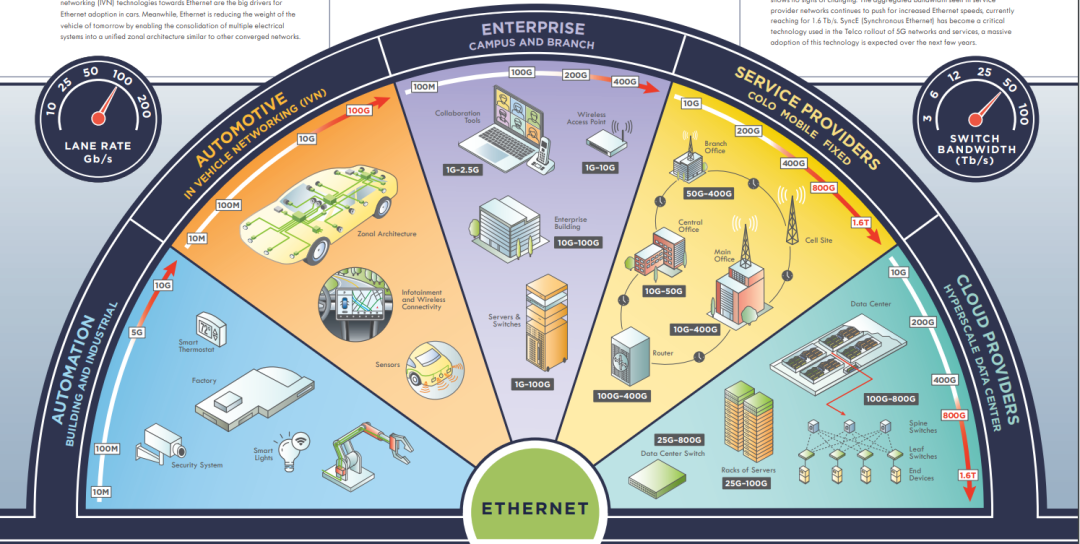
CableDevelopment
In the early days of Ethernet, Bob Metcalfe of Xerox developed the first Ethernet cable in 1973. This coaxial cable transmits a signal at a transmission speed of 10 megabits per second (Mbps). However, it has a larger diameter and lacks flexibility.
In 1985, IEEE released the first Ethernet standard, the IEEE 802.3 standard. This standard defines the basic working principles of Ethernet, including frame structure, media access control methods (such as CSMA/CD protocol), etc. This enables devices from different vendors to interoperate on the same network.
CSMA/CD Protocol
In 1985, the Institute of Electrical and Electronics Engineers (IEEE) released the 802.3 standard for the Carrier Sense Multiple Access with Collision Detection (CSMA/CD) protocol. This protocol requires the device to check whether the line is in use before transmitting a new packet. The CSMA/CD protocol helps handle packet collisions, allowing devices to retransmit when a collision is detected.
TCP/IP Protocol
Prior to the release of the 802.3 CSMA/CD protocol, scientists from the Defense Advanced Research Projects Agency (ARPA) began studying the switching of data packets across radio networks and created the Transmission Control Protocol/Internet Protocol (TCP/IP) in the 1970s. ). TCP/IP becomes the protocol of the transport layer and network layer of the Open Systems Interconnection (OSI) model, and together with Ethernet technology, builds the foundation of computer networks.
Development Of IEEE Standards
When the IEEE established the experimental standard in 1973, it laid the foundation for the development of Ethernet. By issuing a number of standards, especially the first 802.3 standard (CSMA/CD protocol) released in 1985, IEEE formally established Ethernet as a local area network (LAN) technology.IEEE has maintained working groups to support the development of Ethernet. Their ongoing work allows Ethernet to adapt to changing needs and stay ahead of technological developments.
Publication Of Multiple Standards
Since 1985, IEEE has published more than 50 standards, including standards for continuously improving transmission speeds and other performance aspects. This helps ensure that Ethernet technology continues to innovate and meet growing data transmission needs.IEEE works to ensure backward compatibility of new standards, allowing companies to invest in technology without fear of immediate obsolescence. This stability and compatibility helps organizations more easily adopt and integrate new Ethernet technologies.
1)Advantages Of Ethernet
Low signal noise: Ethernet does not require line conditioning of analog lines, so it has lower signal noise, improving the reliability of data transmission.
Reliable data transmission: Because Ethernet is subject to less interference, data transmission is more consistent, providing a high degree of reliability.
Low cost: The cost of laying cables and installing switches and routers is relatively low, making Ethernet more affordable than telecom solutions.
Faster transfer speeds: Using twisted pair cables allows for faster data transfer speeds and better overall performance due to less interference.

2)Future Ethernet Technology Development
Higher data transfer speeds
Studying high-speed data thresholds above 800 Gbps: IEEE has established a research group dedicated to studying high-speed data transmission above 800 Gbps to meet future demand for higher bandwidth. This trend will drive the development of future Ethernet standards to provide support for ultra-high-speed data transmission.
400 Gbps standard: IEEE’s 400 Gbps standard is expected to be released in 2024, providing the basis for higher-level data transmission.
Sustainability and environmental protection
Power over Ethernet (PoE): With increasing concerns about sustainability and environmental protection, Power over Ethernet (PoE) has become an important development path. PoE technology allows data and power to be transmitted through the same network cable to provide power for equipment, reducing the complexity of power lines and energy waste. This technology is of great significance for fields such as smart buildings and Internet of Things devices.
Longer distance transmission
The need for longer distances and faster transmission speeds: As the demand for longer distances and faster transmission speeds continues to grow, future Ethernet technologies will address this challenge. This could involve improved signal processing, higher levels of fiber optic technology, and more powerful network equipment.
3)IoT And Edge Computing
Demand for the Internet of Things: With the rapid development of the Internet of Things, the need to connect a large number of devices and sensors will promote the application of Ethernet technology in the Internet of Things. This may involve more flexible and adaptable network architectures.
Edge computing: With the rise of edge computing, the need for fast, low-latency communication between edge devices will promote the application of Ethernet technology in edge computing scenarios.

Future development of Ethernet technology will continue to be driven by changing market demands and technical challenges. These trends will allow Ethernet to continue to adapt to emerging applications and technology requirements, maintaining its key position in the networking field.
FCST - Better FTTx, Better Life.
We have been designing, manufacturing and supplying passive components for fiber optical networks since 2003. Everything we do in FCST is designed to provide efficient, simple and innovative solutions to solve complicated tasks.
We offer 4 solutions
lFTTH ODN Solution
lUnderground Cable Installation Solution
lAerial Cable Installation Solution
lFiber Tools & Test Solution
As a FTTx solution supplier, we can also do ODM according to project. We will continue to innovate and contribute more to the construction of the global optical fiber network.


